
Key Facts
- HIKING PV’s tandem cell completed 830 continuous thermal shock cycles from -100°C to +100°C, with no observed efficiency degradation after testing.
- A previous 110-cycle thermal shock test showed efficiency degradation below 0.1%; the new test extended the cycle count under the same extreme temperature range.
- After process optimization and upgrade, the same tandem cell kept efficiency degradation below 3% after high-dose proton irradiation at 400 keV and 1×10¹⁵ p/cm².
- The validation covers thermal shock reliability, packaging integrity, conversion-efficiency retention, and performance degradation after proton irradiation.
- The results provide further reliability data for high-efficiency tandem PV power in LEO satellites, near-space vehicles, and commercial space equipment.
Shenzhen, May 29, 2026 — Shenzhen Hiking PV Technology Co., Ltd. (HIKING PV) announced that its tandem solar cell has completed an upgraded round of simulated space-environment validation. The tests focused on two critical operating conditions for space PV: extreme thermal cycling and high-energy proton irradiation, evaluating structural integrity, packaging stability, and conversion-efficiency retention.
The results show that HIKING PV’s tandem cell completed 830 continuous cycles under extreme thermal shock conditions from -100°C to +100°C. After testing, the sample showed no obvious structural damage and no observed conversion-efficiency degradation. After process optimization and upgrade, the cell also kept efficiency degradation below 3% under high-dose proton irradiation at 1×10¹⁵ p/cm² and 400 keV.
No Observed Efficiency Degradation After 830 Thermal Shock Cycles
Sharp high-low temperature cycling in space can continuously stress solar-cell materials, interfaces, and packaging layers. For PV power systems used in low-Earth-orbit satellites, near-space vehicles, and commercial space equipment, thermal shock stability is an important indicator before longer-term space-environment validation.
HIKING PV’s tandem cell had previously completed a 110-cycle extreme thermal shock test from -100°C to +100°C, with efficiency degradation below 0.1%. That result provided initial validation of environmental adaptability under extreme temperature changes.
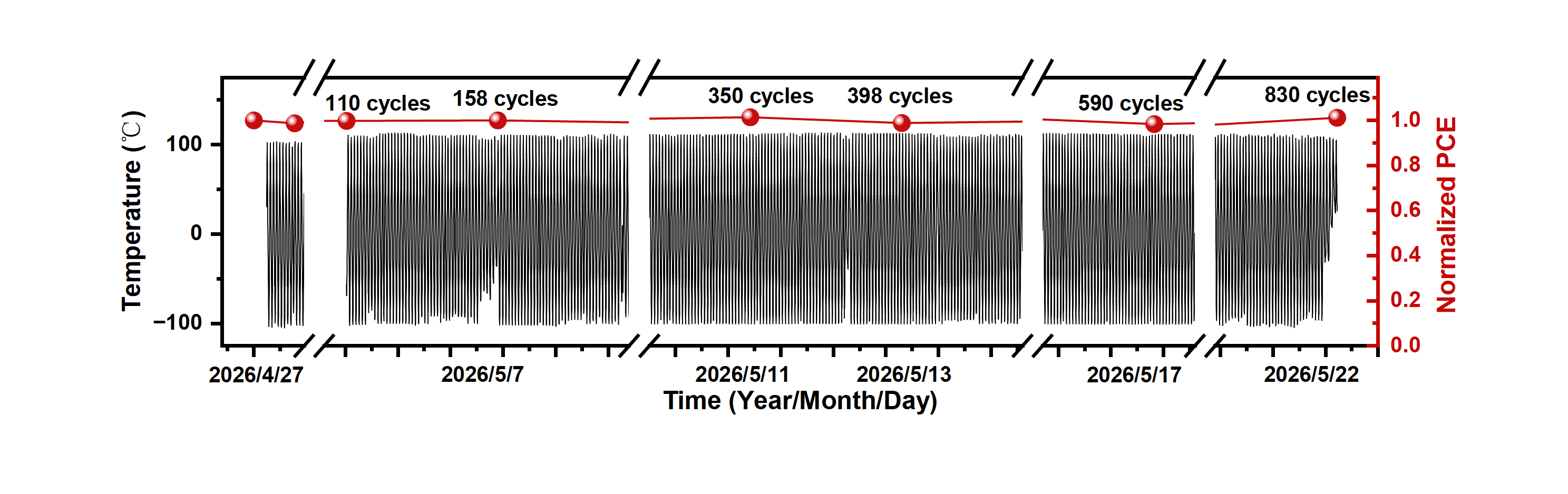
In this upgraded test, the product completed 830 cycles under the same extreme temperature range. After testing, the cell structure remained intact, with no peeling or breakage observed, and no observed conversion-efficiency degradation. Compared with the earlier test, this round extended the number of shock cycles and further evaluated performance retention under longer temperature-alternation conditions.
The result indicates that HIKING PV’s tandem cell has further engineering-validation value for managing extreme temperature fluctuations in space, helping reduce the impact of thermal cycling on efficiency and reliability.
Process Optimization and Upgrade Keeps Proton Irradiation Degradation Below 3%
Low-Earth-orbit environments contain high-energy charged particles such as protons and electrons. Long-term irradiation can increase material defects, degrade interfaces, and reduce output power. Radiation resistance is therefore an important reliability indicator for space solar cells before application evaluation.
In an earlier round of high-dose proton irradiation testing, HIKING PV’s tandem cell before process optimization showed about 12% efficiency degradation under 1×10¹⁵ p/cm² at 400 keV. The company then carried out targeted process optimization and upgrade for long-duration space-residence conditions.
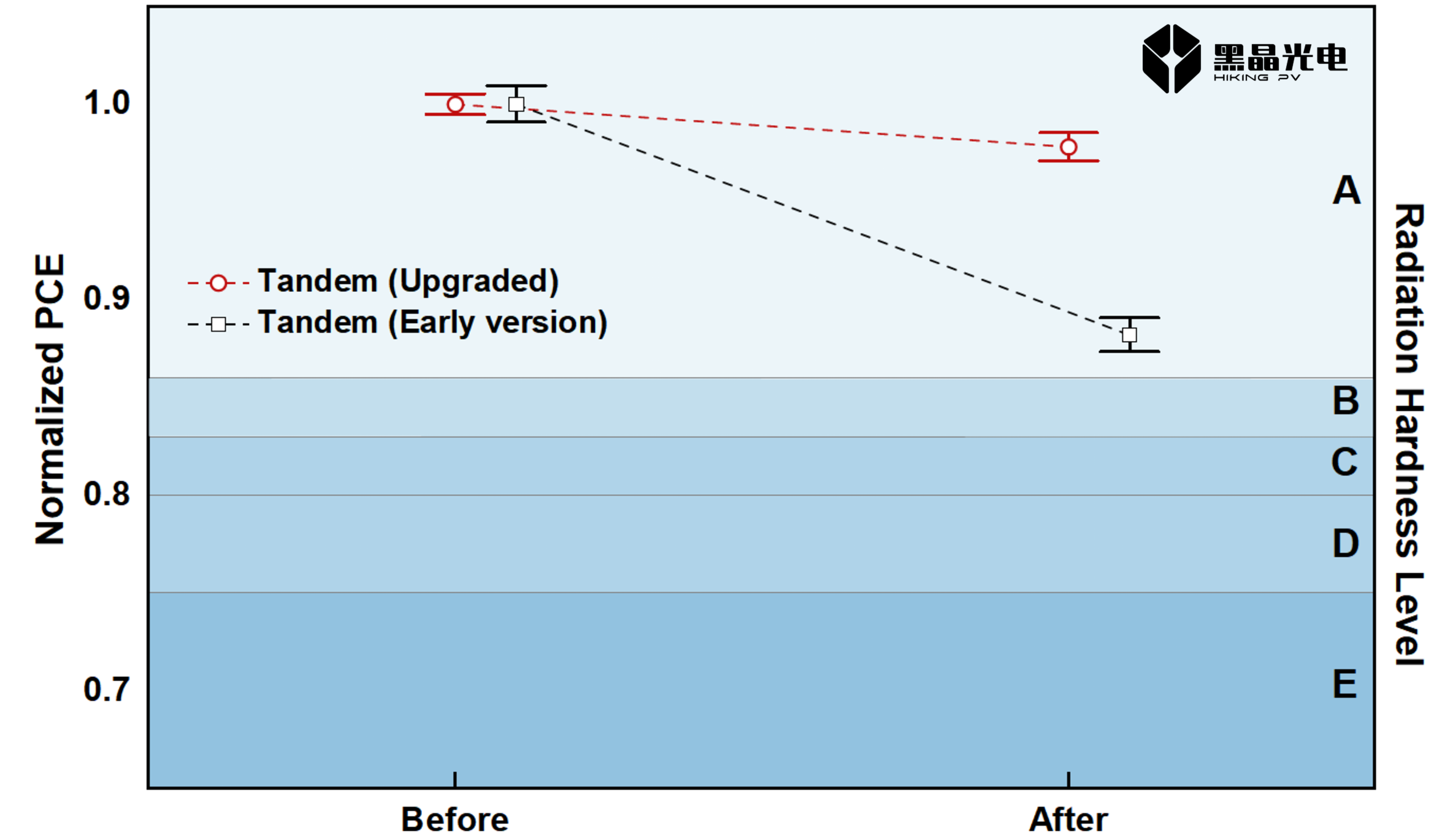
The upgraded tandem cell completed validation under the same high-dose proton irradiation condition, reducing efficiency degradation to below 3%.
From an engineering-application perspective, improved radiation resistance can help tandem cells maintain stable output over longer space missions and provide key data for further validation of domestic high-efficiency tandem PV technology in commercial space applications.
From High Efficiency to High Reliability for Commercial Space PV
Tandem cells are viewed as an important route for next-generation high-efficiency PV. Their value lies not only in the potential to exceed the efficiency limit of single-junction crystalline silicon cells, but also in meeting high-power-density energy requirements through coordinated optimization of materials, device structures, and packaging. Learn more about HIKING PV perovskite-silicon tandem solar cells and tandem technology.
For space PV applications, solar cells need high conversion efficiency, high power density, low degradation, and long-term environmental stability at the same time. The latest thermal shock and proton irradiation results further strengthen HIKING PV’s reliability data foundation for tandem cells in simulated space environments.
As LEO satellites, commercial space systems, near-space vehicles, and space-energy systems continue to develop, demand is rising for lightweight, high-efficiency, and high-reliability solar cells. HIKING PV will continue to improve tandem-cell efficiency, packaging reliability, and space-environment adaptability for next-generation space PV power systems.