
Key Facts
- HIKING PV’s perovskite-silicon tandem solar cell completed a 1×10¹⁵ p/cm² at 400 keV high-dose proton irradiation test.
- Under this sample set and test condition, the tandem cell showed about 12% relative efficiency degradation, within the Grade A radiation-resistance evaluation range.
- The aerospace-grade P-type crystalline silicon reference cell showed about 13% relative efficiency degradation under the same test conditions.
- The result provides staged data for reliability evaluation in space PV, LEO satellites, near-space vehicles, and commercial space applications.
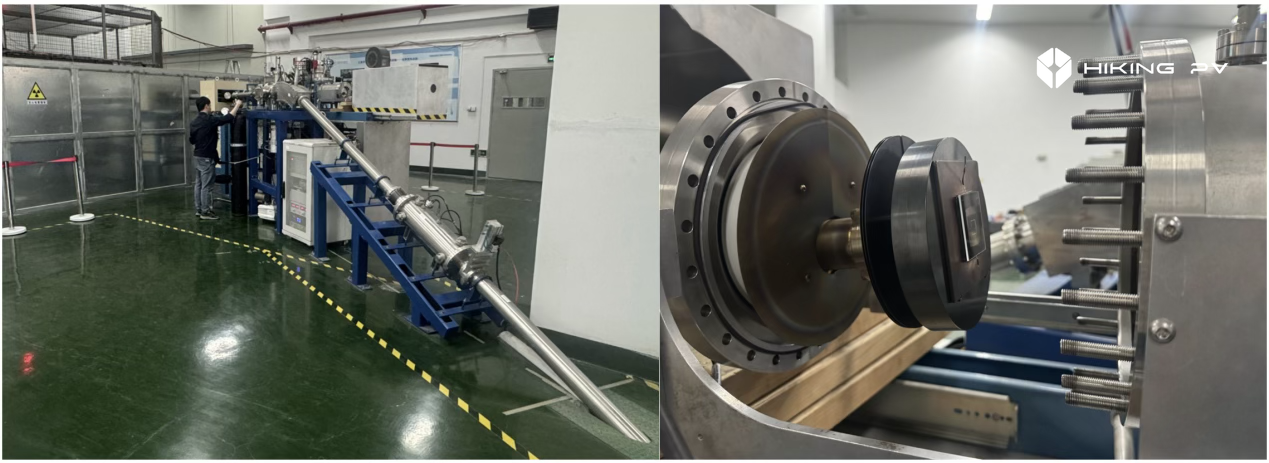
Shenzhen, May 19, 2026 — Shenzhen Hiking PV Technology Co., Ltd. (HIKING PV) announced that its self-developed perovskite-silicon tandem solar cell has completed a 1×10¹⁵ p/cm² at 400 keV high-dose proton irradiation test. The test results show that, under this sample set and test condition, the tandem cell’s proton irradiation resistance was close to that of a conventional aerospace-grade P-type crystalline silicon solar cell.
The test is part of HIKING PV’s staged reliability validation work for space PV applications. The results provide additional data reference for evaluating perovskite-silicon tandem cells in low-Earth-orbit satellites, near-space vehicles, and other commercial space scenarios.
About 12% Relative Efficiency Degradation, Within the Grade A Radiation-Resistance Range
Proton irradiation is an important reliability test for space solar cells. In low-Earth-orbit environments, high-energy charged particles such as protons and electrons can cause long-term performance degradation in solar cells. Radiation resistance is therefore a key indicator that needs to be validated before new photovoltaic devices are evaluated for space applications.
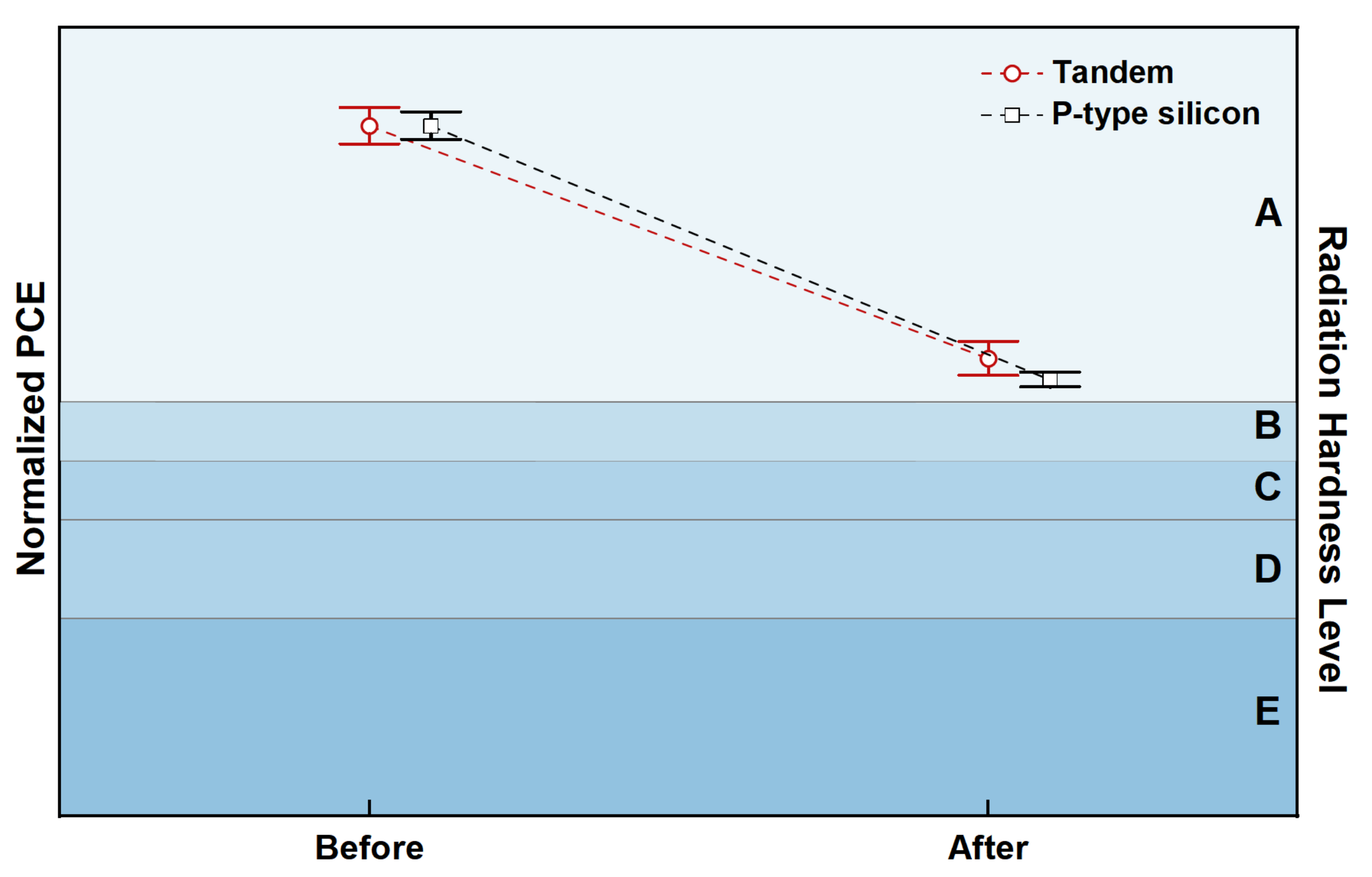
The test data show that after 1×10¹⁵ p/cm² at 400 keV proton irradiation, HIKING PV’s perovskite-silicon tandem cell had about 12% relative efficiency degradation, within the Grade A radiation-resistance evaluation requirement. As a reference, a conventional aerospace-grade P-type crystalline silicon solar cell showed about 13% relative efficiency degradation under the same test conditions.
Based on this round of testing, HIKING PV’s perovskite-silicon tandem cell demonstrated good performance retention under high-dose proton irradiation. Its radiation-resistance level was broadly comparable to that of the reference aerospace-grade P-type crystalline silicon cell.
Building Staged Data for Space Application Reliability Evaluation
Perovskite-silicon tandem solar cells combine high conversion-efficiency potential with industrial scalability, and are regarded as an important direction for next-generation high-efficiency PV technology. For space PV applications, long-term stability under irradiation, temperature changes, and other complex environmental conditions is as important as conversion efficiency.
Before this proton irradiation test, HIKING PV’s perovskite-silicon tandem cell had completed a ±100°C extreme thermal shock test, initially validating its structural stability and performance retention under sharp temperature changes. The completion of this high-dose proton irradiation test further enriches the product’s test data for space-environment adaptability.
HIKING PV said the test result represents staged progress in the company’s evaluation of tandem cells for space applications. The company will continue to advance multiple ground-based simulations of space environments, optimize tandem solar cell performance, and improve operating reliability and scenario adaptability under extreme and complex working conditions.