
With the exponential surge in commercial aerospace missions, the demand for high-efficiency spaceborne power has reached a critical inflection point. Against this backdrop, HIKING PV has redefined the limits of solar technology. Their 2-Terminal (2T) Triple-Junction Tandem Solar Cell recently shattered world records with a conversion efficiency of 30.11%, signaling a historic transition from the traditional “tandem era” to a highly sophisticated “Triple-Junction Era.”
I. Decoding “Triple-Junction”: Solving the Spectral Mismatch Challenge
Traditional photovoltaic systems primarily rely on single-junction silicon cells. Think of these as a coarse filter that only captures energy within a narrow frequency band. However, solar radiation comprises a vast spectrum—from ultraviolet (UV) to infrared (IR). In single-junction cells, high-energy photons are lost as heat, while low-energy photons pass through unabsorbed. This “spectral mismatch” is the primary bottleneck in aerospace energy.
The Triple-Junction Tandem architecture eliminates this inefficiency by “stacking” two specialized perovskite sub-cells atop a high-performance crystalline silicon base. This creates a precision-engineered three-layer absorption system:
1.Top Layer (Wide Bandgap): Purpose-built to harvest high-energy Ultraviolet and Blue light.
2.Middle Layer (Medium Bandgap): Specifically tuned to capture Green, Yellow, and Red light, closing the notorious “green-gap” efficiency loss found in standard dual-junction cells.
3.Bottom Layer (Narrow Bandgap Crystalline Silicon): Responsible for absorbing the high-penetration Deep Red and Near-Infrared spectrum.
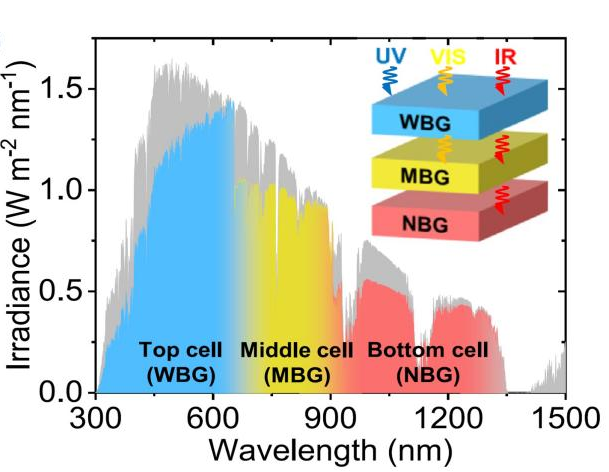
This “division of labor” maximizes photon utilization across the entire solar spectrum. With a theoretical efficiency limit exceeding 50%, this architecture represents a quantum leap over the physical constraints of traditional single-junction technology.
II. Technical Deep Dive: The “Process Barriers” and Core Advantages of 2T Triple-Junction Technology
While the triple-junction tandem concept is theoretically optimal, manufacturing complexity scales exponentially—particularly for the 2-Terminal (2T) architecture championed by HIKING PV.
1. The Engineering Hurdles of 2T Architecture
The 2T architecture presents three primary technical bottlenecks:
- Stringent Current Matching: In a 2T architecture, the three sub-cells function like series-connected components in a single circuit. Consequently, the photocurrent generated by each sub-cell must be perfectly synchronized; the overall efficiency is strictly governed by the sub-cell with the lowest current output. This necessitates sub-nanometer precision in bandgap engineering and layer thickness control.
- Complex Tunnel Junction Integration: Connecting three distinct sub-cells requires a tunnel junction that is both highly transparent and exceptionally conductive. This interface must facilitate seamless carrier transport with negligible voltage loss while remaining transparent enough to allow photons to reach the lower layers without attenuation.
- Manufacturing Process Compatibility: Fabricating two solvent-sensitive perovskite sub-cells sequentially onto a crystalline silicon base is an arduous task. The primary challenge lies in the “dual constraints” of solvent resistance and thermal stability—ensuring that the deposition and treatment of subsequent layers do not degrade the integrity of the underlying structures.
2.The Strategic Imperative: Why 2T is the Future of Space PV
Despite these formidable manufacturing thresholds, the 2T architecture offers irreplaceable system-level advantages for aerospace applications:
- Ultra-Streamlined Architecture: Unlike 4-Terminal (4T) tandem cells that require complex four-electrode configurations, the 2T design utilizes a simple two-electrode lead-out. This significantly simplifies module-level wiring and minimizes parasitic resistance losses across the system.
- Minimized Parasitic Absorption: By eliminating the need for intermediate glass substrates or multiple layers of transparent conductive films (TCOs) required by 4T structures, the 2T architecture drastically reduces unnecessary photon loss between active layers, maximizing light harvesting.
- Superior Power-to-Mass Ratio: In the aerospace sector, weight is the ultimate constraint. The simplified, integrated structure of 2T cells results in a much lighter payload. This directly enhances specific power (W/kg), establishing it as the definitive technical path for next-generation, lightweight aerospace power systems.
III.Core Advantages: Why Aerospace Applications Mandate “Triple-Junction” Technology
In the harsh vacuum of Earth’s orbit and deep space, solar arrays must withstand extreme conditions while delivering maximum performance. Currently, the space sector relies heavily on III-V multi-junction cells—technologies that are highly efficient but prohibitively expensive. Perovskite/Silicon Triple-Junction cells offer a high-performance, cost-effective alternative with natural adaptability across three critical dimensions:
1. Optimized Spectral Response for the AM0 Aerospace Spectrum
The AM0 spectrum (Air Mass Zero, with an irradiance of approximately 1,361W/m²) contains a significantly higher proportion of high-energy, short-wave ultraviolet (UV) radiation than the terrestrial spectrum.
Precision Bandgap Engineering: HIKING PV’s top-cell bandgap is specifically tuned to the AM0 spectrum, allowing for more efficient conversion of high-energy photons compared to traditional single or dual-junction cells.
Thermal Mitigation: By effectively capturing these high-energy photons at the top layer, our technology reduces deep-layer thermal effects and device degradation, ensuring long-term stability in high-radiation environments.
2. Superior Voltage Superposition
The primary technical breakthrough of the triple-junction architecture lies in its ability to achieve significant voltage superposition.
Voltage Gains: By connecting three sub-cells in series, HIKING PV’s technology increases the Open-Circuit Voltage (Voc) by approximately 1,000–1,300 mV compared to standard tandem-junction cells.
System Efficiency: This elevated voltage output directly improves the overall system’s energy efficiency ratio, allowing for more power delivery with lower current-related resistive losses.
Achieving the Ultimate Lightweight Design
For space missions, every gram of payload counts. HIKING PV is pushing the boundaries of “Specific Power”:
Efficiency Benchmarks: With a conversion efficiency exceeding 30%—and continuing to climb—our cells deliver more power per square meter.
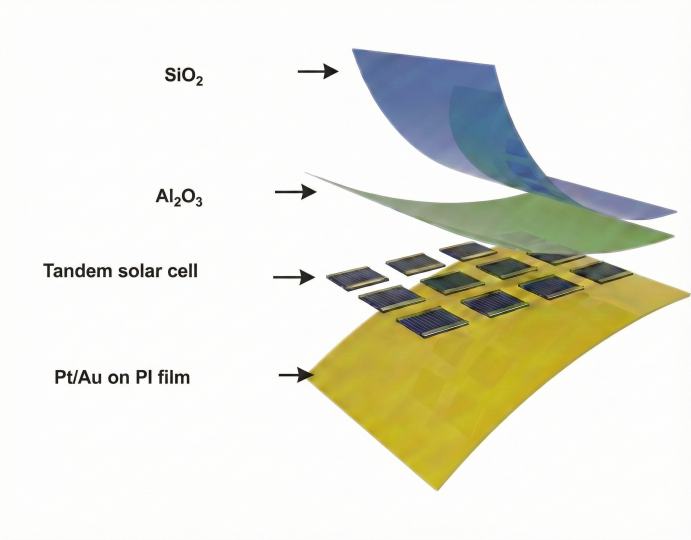
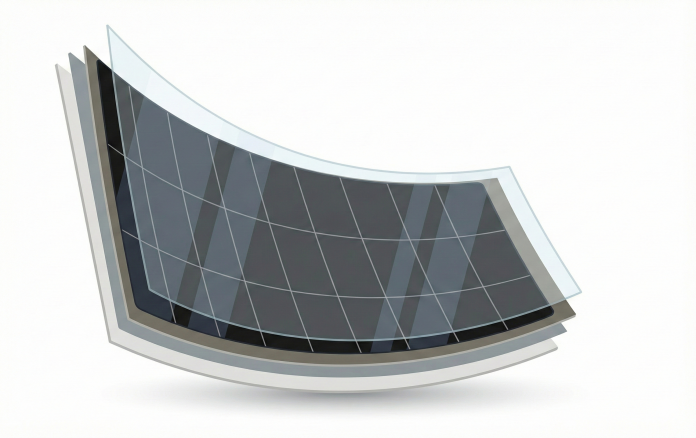
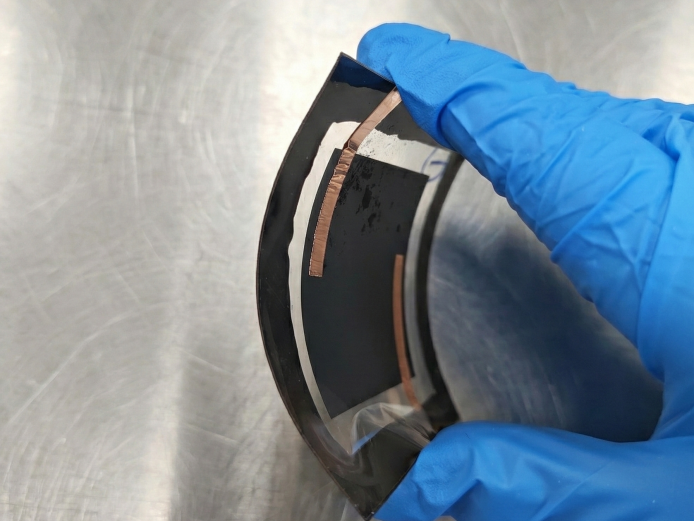
Launch Cost Optimization: When combined with our advanced lightweight packaging, the power-to-weight ratio of HIKING PV modules far exceeds that of traditional crystalline silicon. This directly translates to significant reductions in satellite launch costs and expanded mission capabilities.
IV. HIKING PV: Setting New Records and Defining the Future
At present, HIKING PV’s 2T triple-junction tandem solar cell has successfully achieved a measured conversion efficiency of 30.11%. In the future, with further breakthroughs in radiation resistance stability and modular packaging, lightweight, low-cost and high-efficiency solar modules with an efficiency of 35%-40% will support humanity’s exploration of more distant deep space.
HIKING PV is committed to developing the world’s leading multi-junction tandem solar cells. Through the deep integration of materials science and semiconductor processes, it continuously challenges the limits of photoelectric conversion efficiency, providing core driving force for green energy and the aerospace industry.