
Key Facts
- HIKING PV announced a 2T triple-junction tandem solar cell using a perovskite/perovskite/crystalline silicon structure.
- The cell achieved 30.11% power conversion efficiency certified by a third-party institution.
- The article positions the technology for aerospace applications such as solar-powered UAVs, satellite solar wings, and space computing clusters.
- HIKING PV highlights broader spectral absorption and lightweight design as advantages for improving specific power in aerospace use.
- The technology may reduce manufacturing cost by over 70% compared with existing III-V multi-junction solar cells.
Shenzhen HIKING PV Technology Co., Ltd. is proud to announce a major breakthrough in the field of 2T triple-junction tandem solar cells (Perovskite/Perovskite/Crystalline Silicon). Certified by a third-party institution, the tandem cell has achieved a power conversion efficiency of 30.11%, setting a new world record. This milestone underscores HIKING PV’s formidable R&D capabilities in the cutting-edge tandem solar sector.
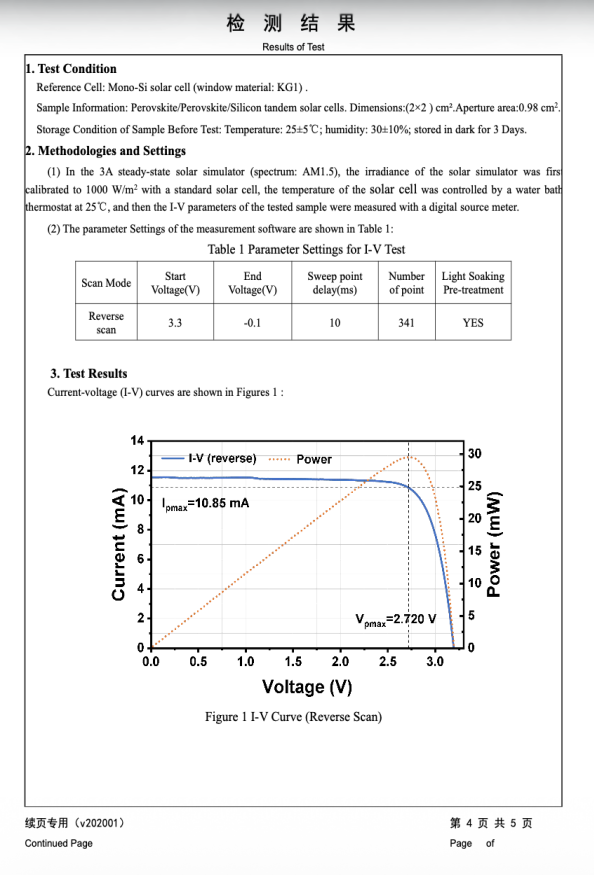
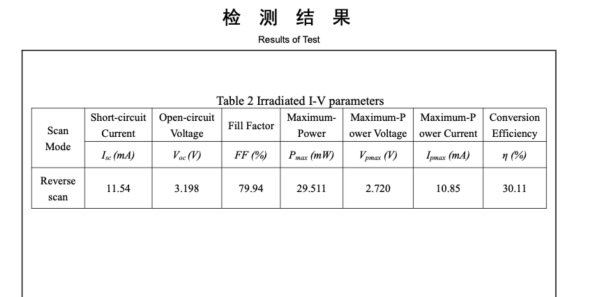
Surpassing the 30% efficiency threshold demonstrates the technology’s immense potential for aerospace applications. It is now perfectly positioned for integration into solar-powered unmanned aerial vehicles (UAVs), satellite solar wings, and space computing clusters, providing a highly efficient and reliable energy solution for space exploration and aerospace engineering.
Compared to traditional space energy technologies, HIKING PV’s tandem solution offers distinct core advantages. It features a broader spectral absorption range and a lightweight design that significantly boosts specific power (W/kg), effectively reducing aerospace payload mass. While current power conversion efficiency is stable at ≥28% – with a roadmap to exceed 39% – the use of novel materials and processes allows for a manufacturing cost reduction of over 70% compared to existing III-V multi-junction solar cells. These advantages offer a new pathway for the aerospace industry to drastically cut satellite manufacturing and launch costs while enhancing performance.
By combining high performance with cost-effectiveness, Perovskite/Perovskite/Crystalline Silicon tandem technology is poised to secure a pivotal position in the future space energy market. This breakthrough is not merely a corporate R&D milestone; it accelerates the expansion of next-generation photovoltaic technology from terrestrial applications to the space domain. It unlocks a multi-billion dollar “blue ocean” market in space energy, injecting new momentum into the convergence of the photovoltaic and aerospace industries.
Looking ahead, HIKING PV remains committed to advancing tandem photovoltaic technology. The Company aims to accelerate the industrialization of these innovations, driving a revolution in both terrestrial and space energy sectors through continuous technological leadership.
FAQ
What efficiency record is reported?
HIKING PV reports a third-party-certified 30.11% power conversion efficiency for its 2T triple-junction tandem solar cell.
What cell structure is described?
The cell is described as a 2T triple-junction tandem solar cell using a perovskite/perovskite/crystalline silicon structure.
Which aerospace applications are mentioned?
Solar-powered unmanned aerial vehicles, satellite solar wings, and space computing clusters are mentioned as potential application areas.
What advantages are highlighted for space energy?
The highlighted advantages include broader spectral absorption, lightweight design, higher specific power, and reduced aerospace payload mass.
How does the article compare costs with III-V multi-junction cells?
Novel materials and processes may reduce manufacturing cost by over 70% compared with existing III-V multi-junction solar cells.