
Key Facts
- Indoor PV is not a large-scale power-generation solution; it is micro-power energy harvesting.
- Indoor light power density is typically two to three orders of magnitude lower than outdoor sunlight.
- Even with high lab efficiency, real continuous output is usually close to 1–10 mW.
- Realistic use cases are limited to ultra-low-power IoT, electronic shelf labels, wireless sensors, and energy harvesting.
- Most systems still need power management, a supercapacitor, or a small battery.
- Stability, system cost, encapsulation, and lead-related compliance further limit commercial adoption.
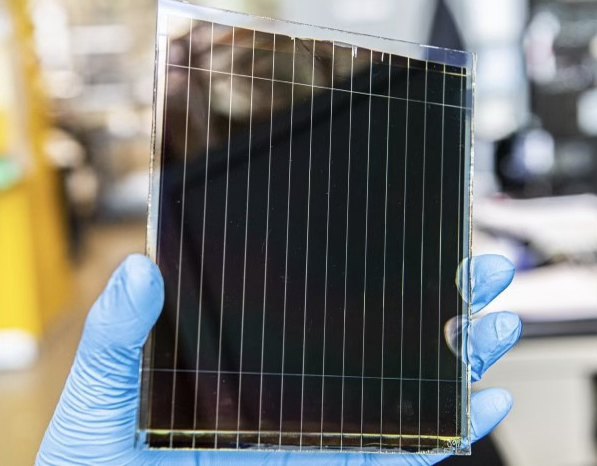
Why Is Indoor PV Getting Attention Again?
For many years, indoor photovoltaics, or indoor PV, remained a relatively marginal research topic. The reason is straightforward: conventional crystalline silicon solar cells are optimized for outdoor sunlight, while indoor environments have weak illumination, different spectra, much lower light intensity, complex light directions, and frequent shading.
As a result, conventional silicon-based PV does not have a clear advantage indoors. After perovskite (PVK) materials gained attention, the industry began to revisit low-light indoor power generation, but that does not mean indoor PV has suddenly become a large-scale energy opportunity.
Perovskite materials offer bandgap tunability, strong visible-light absorption, and relatively high voltage retention under low illumination. These properties make them appear suitable for LED lighting, fluorescent lamps, commercial lighting, smart buildings, and IoT environments.
That has led to many market narratives: no battery replacement, indoor low-light power generation, self-powered IoT, AIoT plus energy harvesting, smart-building energy nodes, and battery-free sensors. These phrases can easily overstate the opportunity. The more important question is whether indoor perovskite PV can create enough commercial value in real systems.
The answer is cautious: it is not meaningless, but it is often exaggerated. The practical boundary for indoor PV is narrow, and the use cases that truly work are much smaller than many promotional narratives suggest.
The Real Nature of Indoor PV: Micro-Power Energy Harvesting
This is the point most easily misunderstood. Many discussions emphasize indoor conversion efficiencies of 30%, 35%, 40%, or even higher. But efficiency alone does not say much if the input energy is extremely small.
Indoor environments simply do not provide much harvestable energy. The real nature of indoor PV is not large-scale power generation; it is micro-power energy harvesting. That is why it cannot support most ordinary electronic devices and should not be packaged as a mainstream energy system.
How Weak Is Indoor Light?
The illuminance gap between typical indoor environments and outdoor sunlight is very large:
| Scene | Typical illuminance |
|---|---|
| Home | 100–300 lux |
| Office | 300–500 lux |
| Retail store | 500–1000 lux |
| Outdoor sunlight | About 100,000 lux |
Indoor illuminance is usually only a few hundredths to one thousandth of outdoor sunlight. More importantly, lux is not the same as actual power. When converted into light power density, the gap remains substantial:
| Scene | Light power density |
|---|---|
| Indoor office environment | About 0.1–1 mW/cm² |
| Standard outdoor sunlight | About 100 mW/cm² |
The difference reaches two to three orders of magnitude. This means that even if indoor perovskite PV reaches 40% efficiency, the actual output power remains low. The core issue is not simply that efficiency is too low; it is that the input energy itself is too limited.
A More Realistic Power Calculation
Assume a perovskite film area of 10 cm × 10 cm, or 100 cm². If the indoor input light intensity is 0.5 mW/cm² and the indoor conversion efficiency is 40%, the power estimate is as follows:
| Parameter | Value |
|---|---|
| Film area | 100 cm² |
| Indoor input light intensity | 0.5 mW/cm² |
| Input power | 50 mW |
| Conversion efficiency | 40% |
| Theoretical output power | 20 mW |
This already assumes ideal lighting, direct alignment to the light source, no shading, high laboratory efficiency, and optimized spectral matching. In real commercial environments, continuous output is usually closer to 1–10 mW. That is the physical boundary of indoor PV and the key reason it is unsuitable for most applications.
What Can 1–10 mW Actually Do?
The answer is: not much. Continuous power in the 1–10 mW range can support only a small set of ultra-low-power devices, and even those devices usually need long sleep periods, low-frequency sensing, short communication bursts, and local energy storage.
Therefore, the realistic direction for indoor perovskite PV is not smartphones, home appliances, cameras, AI boxes, or general consumer electronics. It is ultra-low-power IoT and energy harvesting. Even in these applications, many systems are not powered directly by PVK whenever light is available; they need a power management chip, a supercapacitor, or a small battery as a buffer.
A Few Use Cases That May Work
1. Electronic Shelf Labels (ESL)
Electronic shelf labels are one of the few directions with a realistic basis. E-paper or e-ink displays consume almost no power when static and use energy mainly during refresh events, so their average power consumption is very low.
In this case, the value of indoor PV is not “free power.” It is reducing battery-replacement frequency at scale. Large retailers may operate tens of thousands or even hundreds of thousands of electronic shelf labels, and manually replacing coin-cell batteries can create high maintenance costs.
For this reason, indoor PV plus storage or a small battery may have some commercial meaning in ESL systems. But if it is understood as completely battery-free operation powered only by indoor light, its capability is easy to overestimate.
2. Indoor Wireless Sensors
Indoor wireless sensors include temperature and humidity sensors, CO₂ sensors, people-flow monitoring, occupancy detection, warehouse monitoring, and smart-building environmental nodes. These devices usually sleep most of the time, sample periodically, and transmit data only occasionally, so average power consumption can be very low.
This is one of the few areas where indoor PV may match the system requirement. However, the match depends on μW–mW-level low-power system design, not on “high-power output” from the PV film itself. A realistic commercial system is usually PVK plus a power management chip plus a supercapacitor or small battery.
In other words, pure PVK without storage is not realistic in most cases. Indoor PVK is more likely to extend battery life or reduce maintenance frequency than to fully replace the battery.
The Biggest Problems for Indoor PVK
1. Stability
Even though indoor environments are milder than outdoor conditions, commercial products still need to meet requirements for safety, low degradation, moisture resistance, thermal stability, and reliable encapsulation. If a product fails after a few years or encounters encapsulation issues, the maintenance savings may disappear.
2. System Cost
In many cases, a CR2032 coin-cell battery is cheaper. An indoor PVK system requires a PV film, encapsulation, a power management chip, an energy-storage unit, mechanical design, system integration, and reliability validation. As a result, the return on investment is not automatically attractive.
3. Lead-Related Compliance
Most high-efficiency perovskite materials still contain lead. In consumer electronics, medical devices, retail environments, and public spaces, regulation and encapsulation reliability can become decisive issues.
Conclusion: A Niche Boundary Case, Not a Mainstream Energy Opportunity
Indoor perovskite PV is not completely without value, but its feasible boundary is narrow. It cannot replace outdoor PV as a mainstream energy solution, and it is not well suited to continuously powering smartphones, cameras, AI devices, or ordinary consumer electronics.
A more accurate view is that indoor PV’s commercial value is mainly limited to ultra-low-power IoT and energy harvesting, and many systems still need a battery or energy-storage component. A useful assessment should look beyond laboratory efficiency and consider input light power, system power demand, storage architecture, stability, encapsulation, cost, and compliance.